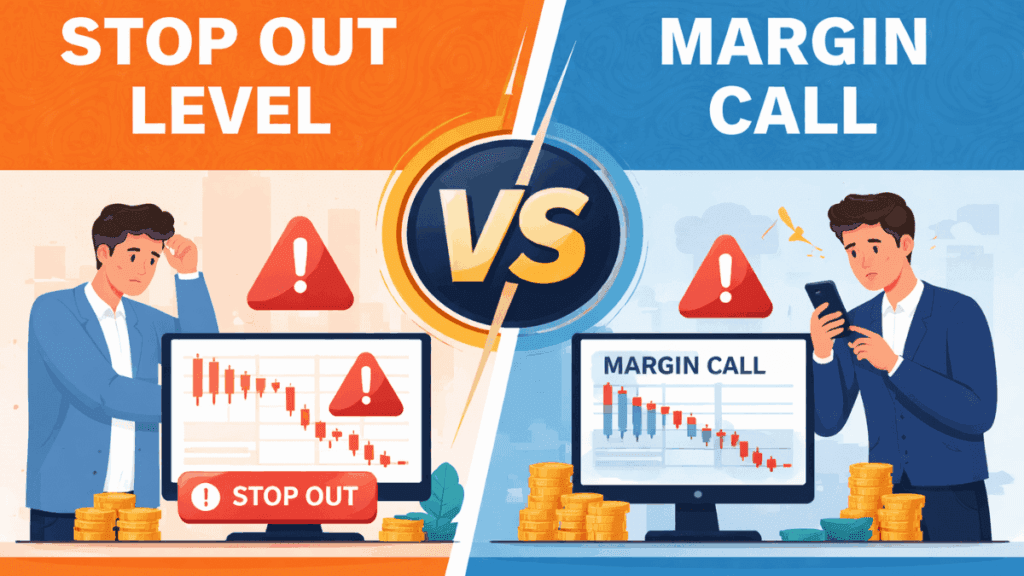
The difference between stop out level vs margin call is one of the most important risk concepts every forex, CFD, or crypto trader must understand. These two terms define how brokers protect themselves when your account runs out of usable funds, and misunderstanding them can wipe out an account faster than any bad trading strategy.
This guide explains margin call and stop out level, shows how they work with real examples, and helps you understand how to avoid reaching either situation.
Understanding Margin and Margin Level
Before comparing stop-out level vs margin call, it is essential to understand how margin works in trading. Margin is not a fee but a portion of your account balance set aside to keep trades open.
Your broker constantly tracks something called margin level, which determines whether your account is safe or at risk.
What Is Margin Level?
Margin level shows how healthy your trading account is and is expressed as a percentage.
Margin Level Formula:
Margin Level = (Equity ÷ Used Margin) × 100
If this percentage drops too low, the broker steps in to protect itself.
What Is a Margin Call?
A margin call is an early warning sign that your account is running out of available funds. It does not close trades automatically but signals that immediate action is required.
How a Margin Call Works
When your margin level falls to a predefined percentage set by your broker, you receive a margin call alert. This alert means you no longer have enough free margin to open new trades, and your current positions are at risk.
At this stage, you still control your account, but time is limited.
Typical Margin Call Levels
Different brokers use different thresholds, but common margin call levels include:
- 100% margin level
- 80% margin level
- 50% margin level (less common)
What You Can Do During a Margin Call
A margin call gives you options, which makes it a critical moment for risk management.
- Add more funds to your trading account
- Close losing positions manually
- Reduce position size to free margin
Ignoring a margin call often leads directly to a stop out.
What Is a Stop Out Level?
A stop-out level is the point at which the broker takes control of your account to prevent further losses. Unlike a margin call, a stop out triggers automatic trade closures.
How a Stop Out Level Works
When your margin level drops to the broker’s stop-out percentage, the system begins closing your trades automatically. Usually, the largest losing trade is closed first to free margin.
This process continues until your margin level rises above the stop-out threshold.
Common Stop Out Levels
Stop out levels vary by broker and account type, but typical levels include:
- 50% margin level
- 30% margin level
- 20% margin level
Lower stop-out levels allow more risk, while higher ones offer stronger account protection.
Stop Out Level vs Margin Call: Core Differences
The confusion between stop out level vs margin call comes from the fact that both are linked to the margin level. The key difference is control—who decides what happens next.
Comparison Table: Margin Call vs Stop Out Level
| Feature | Margin Call | Stop Out Level |
| Purpose | Warning | Forced protection |
| Trigger | Higher margin level | Lower margin level |
| Trade Closure | No automatic closure | Automatic closure |
| Trader Control | Full control | No control |
| Risk Severity | High | Critical |
| Account Outcome | Recoverable | Often damaging |
This table highlights why a margin call is a second chance, while a stop out is a last resort.
Practical Example: Margin Call and Stop Out in Action
Understanding stop-out level vs margin call becomes clearer with a real trading scenario.
Example Scenario
- Account balance: $1,000
- Used margin: $500
- Broker margin call level: 100%
- Broker stop out level: 50%
If your equity falls to $500, your margin level becomes 100%, triggering a margin call. You receive a warning, but your trades remain open.
If losses continue and equity drops to $250, your margin level falls to 50%. At this point, the stop-out level is triggered, and your broker automatically closes trades.
Why Brokers Use Margin Calls and Stop Outs
These mechanisms exist to protect both traders and brokers. Without them, traders could lose more money than they deposit, especially in leveraged markets.
Broker Risk Management
Brokers use margin call and stop out systems to:
- Prevent negative account balances
- Maintain market stability
- Comply with financial regulations
This structure ensures that losses stop before becoming unmanageable.
How Stop Out Levels Differ Between Brokers
Stop out level vs margin call rules are not universal. Each broker sets its own thresholds depending on regulation, account type, and asset class.
Factors That Affect Stop Out Levels
- Regulatory environment (ESMA, FCA, ASIC rules)
- Account type (standard, ECN, professional)
- Market volatility
- Instrument traded
Always check a broker’s trading conditions before opening an account.
How to Avoid Margin Calls and Stop Outs
Avoiding these situations requires discipline, not luck. Most margin calls result from poor risk control rather than bad market direction.
Risk Management Practices That Work
- Use conservative leverage
- Set stop-loss orders on every trade
- Avoid overloading your account with multiple positions
- Monitor the margin level regularly
These habits keep your equity well above danger zones.
Is a Stop Out Worse Than a Margin Call?
A stopout is significantly worse because it removes your decision-making power. Trades are closed at market prices, often during fast-moving conditions.
A margin call, on the other hand, gives you a chance to act and recover before permanent damage occurs.
Stop Out Level vs Margin Call: Key Takeaways
Understanding stop-out level vs margin call is essential for long-term survival in leveraged trading. A margin call is a warning, while a stop out is enforcement.
Successful traders focus on preventing both by managing leverage, position size, and risk exposure. When you control margin, you control your account’s future.
Frequently Asked Questions (FAQs) About Stop Out Level vs Margin Call
The main difference between a margin call and a stop-out level is trader control. A margin call is a warning that your account is running low on usable funds, while a stop-out level forces the broker to close trades automatically to prevent further losses.
A margin call does not automatically close your trades. It simply alerts you that your margin level has fallen too low and action is required. Trades are only closed if the margin level continues to drop and reaches the stop-out level.
The stop-out level depends on the broker and account type. Most brokers set stop-out levels between 20% and 50% margin levels. You should always check your broker’s trading conditions to know the exact threshold.
Yes, a stop out can often be avoided if you act quickly after a margin call. Adding funds, closing losing trades, or reducing position size can raise your margin level and prevent forced liquidation.
Brokers enforce stop-out levels to limit risk for both the trader and the broker. This system helps prevent accounts from going into a negative balance, especially during volatile market conditions.
Yes, a stop-out is usually worse because trades are closed automatically at market prices, which may be unfavorable. Closing trades manually allows you to choose which positions to exit and manage losses more strategically.
Margin call and stop out rules apply to leveraged markets such as forex, CFDs, indices, commodities, and crypto trading with leverage. Spot trading without leverage typically does not involve margin calls or stop-outs.
Beginners can reduce margin call risk by using low leverage, placing stop-loss orders, avoiding oversized positions, and monitoring their margin level regularly. Good risk management is more important than finding perfect trade entries.
Yes, high leverage significantly increases the risk of reaching both margin call and stop-out levels. While leverage can amplify profits, it also magnifies losses and reduces the margin buffer quickly.
Your margin level is displayed in your trading platform, such as MetaTrader 4 or MetaTrader 5. It is usually shown in the trade or terminal window alongside balance, equity, and free margin.
Our Editorial Desk – Focuses on forex trading, gold (XAU/USD), and commodities that move the markets. Our editorial desk blends human insight with AI-powered research to produce sharp, actionable content. We aim to help traders make informed decisions with unbiased market coverage.